From “Cost Centers” to “Value Streams”: The Financial Case for Modern Agile

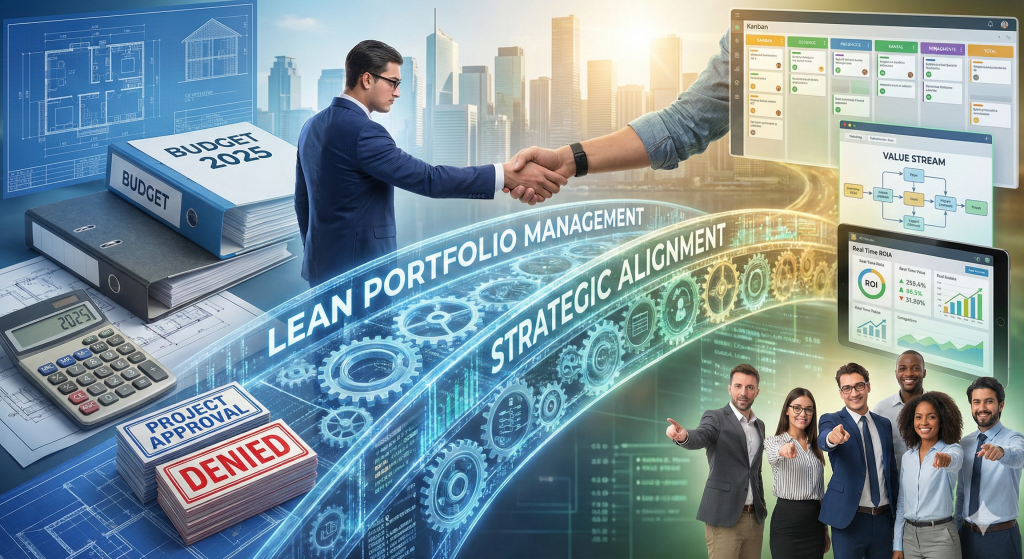
In many organizations, there is a silent tension between the organization that supports Agile changes and the offices that funding projects or initiatives.
On the surface, it looks like an ideological battle: Agility versus Predictability. Flexibility versus Governance.
But as someone who operates at the intersection of engineering management and business strategy, I’ve found that Finance and Agile leaders actually want the exact same things: to maximize Return on Investment (ROI), minimize risk, and ensure the company is working on the most strategic priorities.
The conflict isn’t about goals. It’s about the mechanisms we use to achieve them.
When modern software teams are forced to operate under outdated financial models, friction is inevitable. The key to unlocking true business agility lies not in better Jira workflows, but in bridging this gap through Lean Portfolio Management (LPM).
The Problem with “Project” Funding
For decades, IT was funded like construction projects. You define the scope (the blueprint), estimate the cost, get the budget approved annually, and then execute. Success means delivering that exact scope on time and on budget.
This works for building a bridge. It fails spectacularly for building modern software in a volatile market.
The traditional “Annual Planning Cycle” forces leaders to lock in scope and budgets 12 to 18 months in advance. The moment that budget is approved, it is likely already obsolete due to market shifts, competitor moves, or new technology (like GenAI).
When you fund “Projects,” you incentivize teams to stick to the plan, even when the plan no longer makes sense. Sticking to an outdated plan is the definition of financial waste.
The Paradigm Shift: Funding Value Streams
The shift toward Lean Portfolio Management moves the organization away from funding temporary projects and toward funding long-lived Value Streams.
A Value Stream is simply the series of steps required to deliver value to a customer—for example, the “Consumer Mobile App” or the “B2B Logistics Platform.”
Instead of asking, “How much will this specific feature cost?”, LPM asks, “How much capacity do we want to invest in our Mobile App strategy this year?”
You fund the “team of teams” (the Agile Release Train) as a fixed, predictable operational cost. Then, you empower that structure to figure out the best way to deliver value within that budget constraint, reviewing progress every quarter rather than once a year.
Why the CFO Should Love This Approach
Moving to a Lean Portfolio model doesn’t mean losing control. It means gaining better control.
1. De-Risking Investments (Real Options) Traditional projects are “big bets.” You commit huge sums upfront and don’t know if you’ve won until the very end. LPM places many smaller bets. If an initiative isn’t yielding results after one quarter, you can pivot that budget immediately to a more promising idea. You stop throwing good money after bad.
2. Predictable Spend, Variable Scope Agile teams are actually incredibly predictable financially. Their salaries are fixed. We know exactly what an Agile Release Train costs per sprint. By fixing the cost, we can vary the scope to ensure we are always working on the highest-value items.
3. True Strategic Alignment Often, “Project” budgets get approved based on who shouts the loudest in the boardroom. Lean Portfolio Management uses participatory budgeting and objective guardrails to ensure every dollar spent ties directly back to the company’s top strategic themes.
Bridging the Gap
Agile cannot stop at the team level. If your engineering teams are sprinting, but your funding model is still crawling, you will never achieve true business agility.
At Perimeter Designs, we help organizations navigate this critical transition. We don’t just teach Scrum to developers; we help Engineering and Finance leadership speak the same language, aligning capital investment with agile execution. Let’s turn your technology cost center into a strategic value engine.